I like cars. Specifically, I like a good manual transmission, all wheel drive, and something that strikes a good balance between handling and comfort. Those requirements can only satisfied by the Germans. Specifically, expensive German cars. If I still made gobs of money like I did on active duty at the Pentagon, would it be ok to buy a loaded 3-series BMW with a manual and all wheel drive? Let’s extend that question to all types of luxury items. What about living in an upscale area, or having a vacation home, or having expensive clothes, or jewelry? What about non-luxury but unnecessary goods that you don’t need like a big house, going on vacation, or expensive hobbies? As with any of the topics I’m addressing, you’ll find I’m not proscriptive but will focus instead on process and intent – things to help you make your decisions.
Let’s first talk about the concept of value. I don’t mean cost; I mean the concept in utility theory. In a non-mathematical definition, value is the amount and quality of stuff you get per dollar spent. When someone asks about the “bang for your buck” they are asking about that product’s value. The method for assessing value is not so important as is the general concept as it relates to luxury items. What is important is how this measuring of value plays out amongst similar products of varying costs and value. You must compare similar products – mid-size sedans, for example, or this won’t work. In order to assess which is the best deal or the best “bang for buck” mathematicians plot products on a graph to make what’s called a value curve. The X-axis is cost and the Y-axis represents value. Here’s a simplified graph:
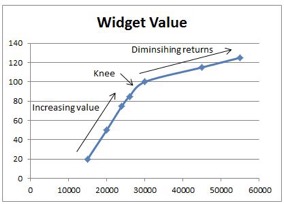
The knee in the curve tells all. Look at the cost per unit of value. It goes down – which means it’s a better value – as the cost approaches the knee. Why does this matter? Because luxury items sit on the right side of the knee. The more you spend on them the less additional value you get. By definition, a luxury item isn’t worth the cost. You pay a premium for the status of ownership and the reduced economy of scale in production – and that’s the whole point. You get a little bit more value at a lot more cost, for the status or novelty of ownership.
While I consider assessing value to be important in making a purchase, my advice to you is to use it as a guide, not a hard and fast rule. There’s no rule that says you can’t buy something to the right of the knee. The point of bringing it up is simply to make you aware of the mechanism at work and to give you a tool to make wise decisions.
 The Way of Humble Living
One thought on “The Knee in the Curve of Luxury Goods”